

 3
3 0
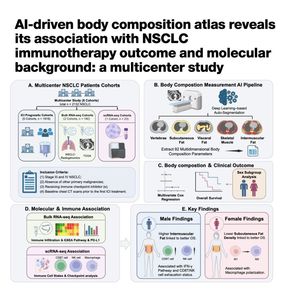
0The paper details a large-scale multicenter study that utilized deep learning to analyze how body composition affects treatment outcomes for patients with non-small cell lung cancer receiving immunotherapy. Researchers developed an AI-driven pipeline to extract nearly 100 parameters from CT scans, discovering that specific fat and muscle distributions are significant independent predictors of survival. The study highlights critical gender-specific differences, noting that high intermuscular fat correlates with better survival in men, while different subcutaneous fat metrics are more relevant for women. By integrating genomic data, the authors demonstrate that these physical characteristics are linked to the tumor microenvironment, specifically affecting immune cell activation and exhaustion levels. Ultimately, this research suggests that automated body composition profiling can serve as a non-invasive tool to help clinicians identify which patients are most likely to benefit from immune checkpoint inhibitors.
References:
Guo, Y., Gong, B., Lou, J. et al. AI-driven body composition atlas reveals its association with NSCLC immunotherapy outcome and molecular background: a multicenter study. npj Precis. Onc. 10, 185 (2026). doi.org
