

 0
0 0
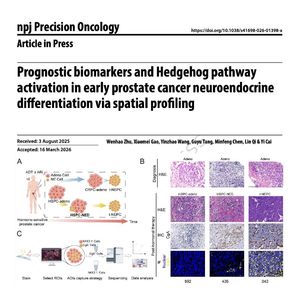
0This manuscript examines the emergence of neuroendocrine differentiation (NED) during the early stages of prostate cancer progression. By utilizing spatial transcriptomics and single-cell RNA sequencing, researchers identified a distinct molecular subtype in hormone-sensitive tissues that predicts a poor clinical prognosis. The study established a six-gene biomarker panel—comprising FMN2, APLP1, SCG2, SCG3, CHGB, and RIMBP2—to effectively identify patients at high risk for treatment resistance. Furthermore, the authors discovered that the Hedgehog signaling pathway specifically drives these early cellular changes before the disease shifts to Myc-driven proliferation in later stages. These findings provide a framework for early diagnosis and suggest stage-specific therapeutic targets to prevent the transition into aggressive, treatment-related neuroendocrine prostate cancer.
References:
Zhu, W., Gao, X., Wang, Y. et al. Prognostic biomarkers and Hedgehog pathway activation in early prostate cancer neuroendocrine differentiation via spatial profiling. npj Precis. Onc. (2026). doi.org
