

 0
0 0
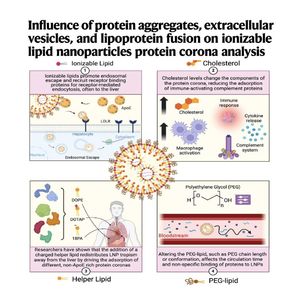
0This paper explores the complex biological interface of ionizable lipid nanoparticles (LNPs) used in nucleic acid therapies. While traditional hard nanoparticles form a stable protein corona shell, researchers suggest that soft LNPs interact with biological fluids through lipoprotein fusion and selective protein integration. This distinction is critical because extracellular vesicles and other blood-borne contaminants often interfere with the accurate proteomic analysis of LNP surfaces. By refining isolation and imaging strategies, such as using cryo-electron microscopy, scientists aim to better understand how lipid composition influences organ-specific targeting and therapeutic efficacy. Ultimately, the authors propose a paradigm shift toward viewing the LNP interface as a dynamic mosaic rather than a rigid, adsorbed layer.
References:
Borhan B, Murray A M, Saei A A, et al. Influence of protein aggregates, extracellular vesicles, and lipoprotein fusion on ionizable lipid nanoparticles protein corona analysis[J]. Nature Communications, 2026, 17(1): 5261.
