

 1
1 0
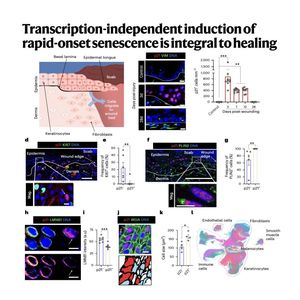
0This research identifies a unique form of rapid-onset senescence that is essential for effective skin wound healing. Unlike traditional senescence which develops over several days, this response occurs within minutes or hours through the translation of pre-existing Cdkn1a mRNA rather than new transcription. These senescent cells concentrate at the injury edge, where they stop dividing and secrete factors that stimulate inflammation and cell migration to close the wound. The study demonstrates that p21-positive cells act as temporary guides for tissue regeneration, and their absence significantly slows down the repair process. By mapping these cells in a single-cell RNA-seq atlas, the authors highlight how specific proteins like EPGN are vital for re-epithelialization. Ultimately, the findings establish that the immediate induction of senescence is a programmed, mechanical requirement for successful physiological recovery after trauma.
References:
Valdivieso K, Rozmaric T, Victorelli S, et al. Transcription-independent induction of rapid-onset senescence is integral to healing[J]. 2024.
