

 0
0 0
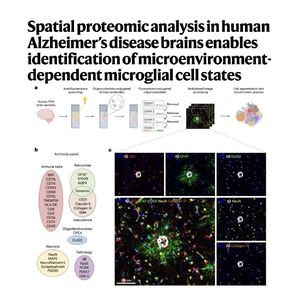
0This research introduces CODEX-CNS, a specialized multiplexed protein imaging technology designed to map the complex cellular landscape of the human brain. By developing a custom protocol to eliminate tissue interference, the authors successfully profiled over 700,000 individual cells to study the progression of Alzheimer’s disease. The study identifies a specific group of human plaque-associated microglia that physically cluster around dense amyloid-β deposits. These findings demonstrate that a cell’s identity and behavior are heavily influenced by its local spatial neighborhood and immediate microenvironment. Furthermore, the work provides a high-resolution atlas of how neurons, astrocytes, and immune cells interact within the diseased brain's architecture. Ultimately, this new approach offers a powerful framework for discovering proteomic signatures that remain hidden in traditional single-cell analysis.
References:
Sanchez-Molina P, Rosmus D D, Brownell D, et al. Spatial proteomic analysis in human Alzheimer’s disease brains enables identification of microenvironment-dependent microglial cell states[J]. Nature Neuroscience, 2026: 1-16.
