

 1
1 0
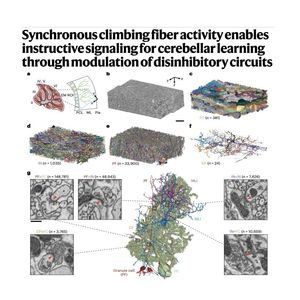
0This research explores how the cerebellum selectively permits motor learning through a complex disinhibitory circuit triggered by specific neural activity. By utilizing high-resolution electron microscopy and functional recordings, scientists discovered that climbing fibers do not just communicate with Purkinje cells, but also activate a specific subtype of interneuron that inhibits other inhibitory cells. This internal override, known as serial disinhibition, is most effective when multiple climbing fibers fire in synchrony, signaling a significant motor error. This process temporarily removes the "brakes" on the system, allowing for the calcium-driven plasticity required to refine physical movements. Ultimately, the study reveals that instructive signaling in the brain is not merely a product of individual messages, but an emergent property of coordinated network dynamics.
References:
Park C, Yang Z, Nashef A, et al. Synchronous climbing fiber activity enables instructive signaling for cerebellar learning through modulation of disinhibitory circuits[J]. Nature Neuroscience, 2026: 1-14.
