

 0
0 0
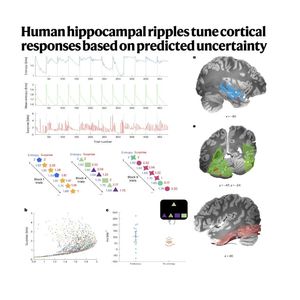
0This research investigates how the human hippocampus communicates with the visual cortex to manage uncertainty and predictive processing. Using intracranial recordings from patients, the study demonstrates that hippocampal ripples—brief, high-frequency neural oscillations—increase in frequency and duration before a person encounters unpredictable information. These prestimulus ripples appear to act as a precision-weighting mechanism, suppressing gamma activity in the visual cortex to prepare the brain for expected information gain. By linking hippocampal activity to predictive coding, the authors show that ripples help the brain generate top-down predictions and modulate bottom-up prediction errors. Ultimately, the findings reveal that the hippocampus plays a crucial role in perceptual synthesis and memory by tuning cortical responses based on how predictable a situation is.
References:
Frank D, Moratti S, Hellerstedt R, et al. Human hippocampal ripples tune cortical responses based on predicted uncertainty[J]. Nature Neuroscience, 2026: 1-12.
