

 3
3 0
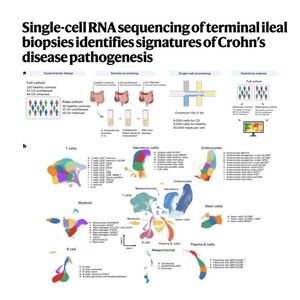
0The paper describes IBDverse, a massive single-cell RNA sequencing dataset containing over 1.1 million cells from patients with Crohn’s disease and healthy controls. Researchers utilized this resource to identify 57 distinct cell clusters, revealing that inflammation triggers widespread interferon-driven changes and immune signaling within the intestinal lining. A significant finding is that these molecular markers of damage, specifically MHC-I upregulation, can persist in stem-like cells even after physical inflammation has cleared. The study also highlights ITGA4+ macrophages as central drivers of the disease's inflammatory process through the JAK–STAT signaling pathway. Finally, genetic analysis confirms that susceptibility to Crohn’s disease is linked to specific immune cell populations, providing a framework for developing more effective, targeted therapies.
References:
Krzak M, Alegbe T, Taylor D L, et al. Single-cell RNA sequencing of terminal ileal biopsies identifies signatures of crohn’s disease pathogenesis[J]. Nature Genetics, 2026: 1-10.
