

 0
0 0
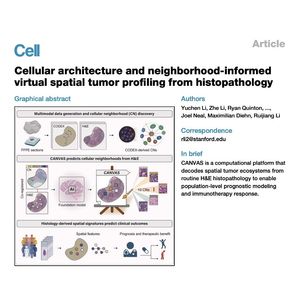
0The paper introduces CANVAS, an innovative artificial intelligence platform designed to decode the complex spatial architecture of tumors using standard, widely available clinical images. By analyzing an extensive atlas of over 18 million cells through high-dimensional spatial proteomics, the researchers identified ten distinct cellular neighborhoods that define the lung cancer microenvironment. CANVAS successfully translates these deep molecular insights into a format compatible with routine H&E histopathology, allowing for the "virtual" profiling of tumor habitats without expensive specialized equipment. This technology enables clinicians to predict patient prognosis and evaluate how individuals might respond to immunotherapy by identifying specific spatial signatures of immune exclusion or activation. Ultimately, the system bridges the gap between sophisticated single-cell research and large-scale clinical application, offering a scalable tool for precision oncology.
References:
Li Y, Li Z, Quinton R, et al. Cellular architecture and neighborhood-informed virtual spatial tumor profiling from histopathology[J]. Cell, 2026.
