

 0
0 0
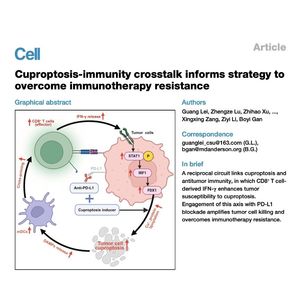
0This research identifies a reciprocal relationship between cuproptosis, a copper-induced form of cell death, and antitumor immunity. The study demonstrates that cuproptotic tumor cells act as immunogenic cell death, releasing signals that activate dendritic cells and prime CD8+ T cells. In a feedback loop, these activated T cells release interferon-gamma (IFN-γ), which triggers the STAT1-IRF1 signaling pathway to increase FDX1 expression, making tumor cells even more vulnerable to copper-induced death. By leveraging this "crosstalk," the authors show that combining cuproptosis inducers with anti-PD-L1 therapy can effectively bypass both intrinsic and acquired immunotherapy resistance. This dual approach significantly reduces tumor growth and metastasis in various preclinical models while maintaining a favorable safety profile. The findings suggest that targeting this specific metabolic death pathway could be a powerful clinical strategy to enhance the efficacy of cancer immunotherapies.
References:
Lei G, Lu Z, Xu Z, et al. Cuproptosis-immunity crosstalk informs strategy to overcome immunotherapy resistance[J]. Cell, 2026.
