

 5
5 0
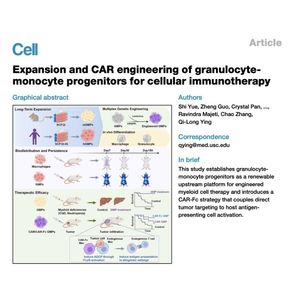
0Researchers have developed a scalable manufacturing platform for immunotherapy by enabling the long-term expansion of granulocyte-monocyte progenitors (GMPs). By identifying that myeloperoxidase (MPO) inhibition unlocks sustained proliferation, the authors created defined culture conditions to produce vast quantities of these myeloid precursors from both mice and humans. Unlike terminal macrophages, these engineered progenitors engraft in hematopoietic niches, providing a continuous supply of donor-derived immune cells that persist and infiltrate tumors. The study demonstrates that CAR-engineered GMPs effectively suppress leukemia and solid tumors while offering superior genetic flexibility compared to mature cells. Furthermore, a novel CAR-Fc architecture was introduced to recruit host immune cells, successfully overcoming major histocompatibility barriers to trigger systemic T cell activation. Together, these findings establish expandable GMPs as a potent, renewable source for next-generation cellular cancer treatments.
References:
Yue S, Guo Z, Pan C, et al. Expansion and CAR engineering of granulocyte-monocyte progenitors for cellular immunotherapy[J]. Cell, 2026.
