

 0
0 0
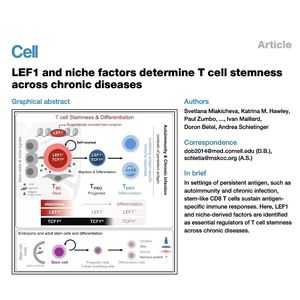
0This article identifies LEF1 as the critical transcription factor that defines self-renewing stem T cells (TSC) within autoimmune and chronic infection environments. While TCF1 was previously considered the primary marker for progenitor T cells, researchers discovered that only the small subset expressing LEF1 possesses true long-term persistence and regenerative capacity. The study details a specific cellular hierarchy where LEF1+ TSC give rise to TPRO progenitors, which eventually become terminally differentiated TDIFF cells. By utilizing CRISPR/Cas9 gene editing and single-cell multiomics, the authors demonstrate that losing LEF1 eliminates the stemness program and halts the progression of autoimmune disease. Furthermore, the research highlights that these specialized T cells adopt survival modules from embryonic and adult somatic stem cells to maintain their function. Finally, the findings suggest that niche signals and spatial positioning are essential for regulating this unique epigenetic state across different chronic conditions.
References:
Miakicheva S, Hawley K M, Zumbo P, et al. LEF1 and niche factors determine T cell stemness across chronic diseases[J]. Cell, 2026.
