

 0
0 0
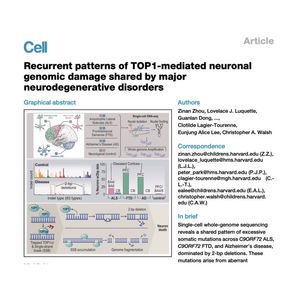
0This research identifies a universal mechanism of genetic instability that links three major neurodegenerative disorders: ALS, FTD, and Alzheimer’s disease. By using single-cell whole-genome sequencing, scientists discovered that neurons in these diseased brains accumulate an excessive number of somatic mutations, most notably a specific signature of 2-base-pair deletions. These mutations are caused by the malfunction of topoisomerase 1 (TOP1), an enzyme that becomes trapped on DNA during periods of high oxidative stress. This process leads to single-strand DNA breaks and eventual genome fragmentation, which contributes to the death of neurons across diverse pathological types. Interestingly, these genetic defects were found in both TDP-43 and tau proteinopathies, suggesting that genomic damage is a common driver of decay in various forms of dementia.
References:
Zhou Z, Luquette L J, Dong G, et al. Recurrent patterns of TOP1-mediated neuronal genomic damage shared by major neurodegenerative disorders[J]. Cell, 2026.
