

 0
0 0
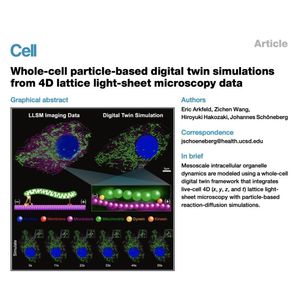
0Researchers have developed a whole-cell digital twin framework that bridges the gap between live-cell imaging and computational modeling to simulate complex organelle dynamics. By integrating 4D lattice light-sheet microscopy (LLSM) with particle-based simulations, the authors created high-resolution models of mitochondria and microtubule networks within human cells. These digital twins accurately predict how mitochondria move and remodel in response to pharmacological disruptions without needing manual parameter adjustments. The study specifically highlights that microtubule topology serves as a structural gatekeeper, determining whether mitochondria cluster near the nucleus. This platform offers a powerful, biologically grounded tool for investigating intracellular behavior and predicting the effects of cellular stress or disease.
References:
Arkfeld E, Wang Z, Hakozaki H. Whole-cell particle-based digital twin simulations from 4D lattice light-sheet microscopy data. Cell, 2026; 0
