

 0
0 0
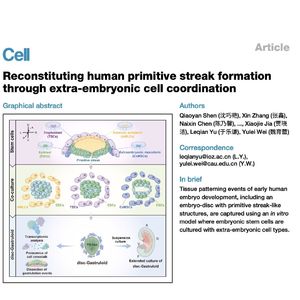
0The research introduces disc-gastruloids, a sophisticated in vitro model designed to simulate the early stages of human gastrulation and primitive streak formation. By utilizing a specialized co-culture system, the authors demonstrate how specific extra-embryonic tissues—namely the amnion, trophoblast, and extra-embryonic mesoderm—coordinate to regulate embryonic development. The study reveals that amniotic cells initiate gastrulation signaling, trophoblasts provide inhibitory boundaries, and mesodermal stem cells guide the directional migration of developing cells. Through microengineering, the researchers reconstructed the spatial architecture of a two-week-old embryo, allowing for the observation of tissue patterning and axis establishment. This breakthrough provides a stable platform to investigate previously inaccessible windows of human development without the need for external growth factors or chemical inhibitors. Extended culture of these models further showed their potential to form complex, embryo-like structures featuring neural, cardiac, and gut progenitor cells.
References:
Shen Q, Zhang X, Chen N, et al. Reconstituting human primitive streak formation through extra-embryonic cell coordination[J]. Cell, 2026.
