

 0
0 0
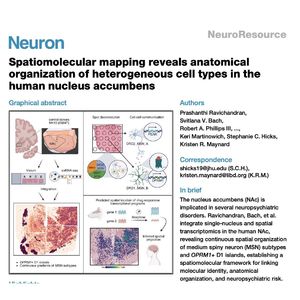
0Researchers have developed a comprehensive spatiomolecular atlas of the human nucleus accumbens (NAc) by integrating single-nucleus and spatial transcriptomics. Their findings reveal that the anatomical layout of this brain region is defined by continuous transcriptional gradients and complex cell-type distributions rather than simple, binary boundaries. A key discovery includes the identification of evolutionarily conserved D1 islands enriched with the mu-opioid receptor, which serve as critical hubs for opioid and stress-related signaling. By applying transfer learning and genetic risk analysis, the study links specific medium spiny neuron subtypes to neuropsychiatric disorders and addiction-related traits. Furthermore, the authors mapped the spatial impact of morphine and cocaine responses, demonstrating how drug-responsive gene programs align with the NAc’s cellular architecture. Collectively, this work provides a robust framework for understanding how molecular identity and spatial organization contribute to human reward circuitry and psychiatric risk.
References:
Ravichandran P, Bach S V, Phillips R A, et al. Spatiomolecular mapping reveals anatomical organization of heterogeneous cell types in the human nucleus accumbens[J]. Neuron, 2025.
