

 0
0 0
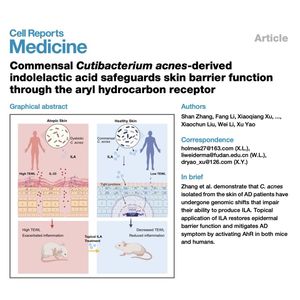
0This research identifies a significant link between the skin bacterium Cutibacterium acnes and the maintenance of a healthy skin barrier in patients with atopic dermatitis (AD). Scientists discovered that AD-associated strains of this bacteria have a reduced capacity to produce indolelactic acid (ILA), a metabolite essential for skin health. Through experimental models, the study shows that applying ILA topically activates the aryl hydrocarbon receptor (AhR) in skin cells, which strengthens tight junctions and lowers inflammatory markers like IL-33. These findings were supported by a clinical trial showing that ILA treatment effectively reduces water loss and eases symptoms in humans. Ultimately, the study suggests that restoring this specific bacterial metabolite offers a promising new therapeutic strategy for managing chronic skin inflammation.
References:
Zhang S, Li F, Xu X, et al. Commensal Cutibacterium acnes-derived indolelactic acid safeguards skin barrier function through the aryl hydrocarbon receptor[J]. Cell Reports Medicine, 2026.
