

 6
6 0
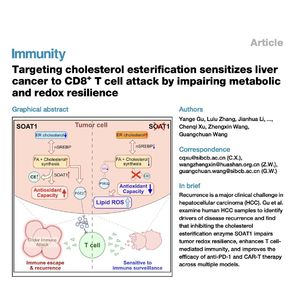
0This research identifies the enzyme SOAT1 as a primary driver of immune evasion and cancer recurrence in hepatocellular carcinoma (HCC). By analyzing human patient samples and mouse models, the authors demonstrate that SOAT1 supports tumor resilience by converting free cholesterol into esters, which maintains the metabolic and antioxidant capacity of cancer cells. Inhibiting this enzyme leads to cholesterol accumulation in the endoplasmic reticulum, disrupting lipid synthesis and leaving tumors vulnerable to lipid peroxidation. Consequently, targeting SOAT1 enhances the effectiveness of immunotherapies, such as anti-PD-1 and CAR-T cell treatments, by increasing CD8+ T cell infiltration and function. Ultimately, the study suggests that pharmacological or genetic suppression of SOAT1 could prevent post-surgical relapse and improve outcomes for liver cancer patients.
References:
Gu Y, Zhang L, Li J, et al. Targeting cholesterol esterification sensitizes liver cancer to CD8+ T cell attack by impairing metabolic and redox resilience[J]. Immunity, 2026.
