

 0
0 0
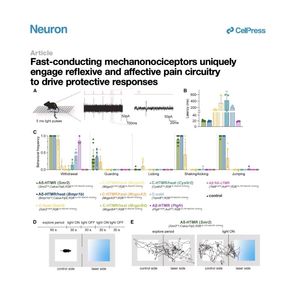
0This research identifies and characterizes two distinct populations of fast-conducting nerve fibers, known as Aδ-HTMRs, that are essential for detecting damaging mechanical stimuli and triggering protective pain responses. Unlike most previously studied pain-sensing neurons, these myelinated nociceptors possess unique physiological and anatomical traits that allow for ultra-fast reflexive withdrawals and high-level aversive learning. These neurons provide dense innervation to the skin, bones, and internal organs, forming specialized nest-like synapses onto specific projection neurons in the spinal cord. By utilizing an optogenetic screening approach, the authors demonstrate that these specific cells are the primary drivers of acute mechanical pain in healthy subjects. Their removal results in spontaneous tissue damage, highlighting their critical role in bodily preservation. Ultimately, the discovery of these genetically defined pathways offers new targets for developing analgesics to treat various pain conditions.
References:
Lezgiyeva K, Liu J, Nguyen K, et al. Fast-conducting mechanonociceptors uniquely engage reflexive and affective pain circuitry to drive protective responses[J]. bioRxiv, 2025: 2025.11. 11.687663.
