

 0
0 0
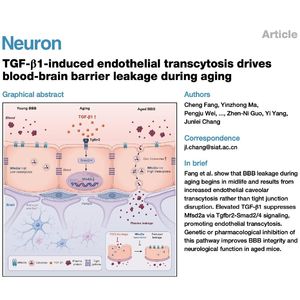
0The study investigates the molecular mechanisms behind blood-brain barrier (BBB) breakdown during aging, revealing that leakage begins in midlife due to increased endothelial caveolar transcytosis. Research shows that elevated levels of TGF-β1 in the brain and blood suppress the lipid transporter Mfsd2a, a protein essential for maintaining barrier integrity by inhibiting vesicular transport. This downregulation of Mfsd2a is driven by TGF-β1-induced Tgfbr2-Smad2/4 signaling within the brain's microvascular endothelial cells. Experiments on aged mice demonstrate that blocking TGF-β signaling or restoring Mfsd2a expression effectively reduces barrier permeability and improves cognitive function. Ultimately, the sources identify the TGF-β1-Mfsd2a axis as a critical pathway for age-related neurovascular decline and a potential target for therapeutic intervention. This work shifts the focus of age-related vascular research from tight junction failure to the hyperactivation of specific transcellular transport pathways.
References:
Fang C, Ma Y, Wei P, et al. TGF-β1-induced endothelial transcytosis drives blood-brain barrier leakage during aging[J]. Neuron, 2026.
