

 0
0 0
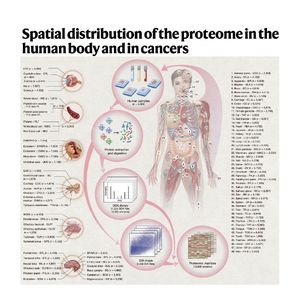
0This comprehensive study establishes a detailed quantitative map of the human proteome, profiling over 13,000 proteins across various physiological states and 58 major tissue types. By utilizing data-independent acquisition mass spectrometry, researchers analyzed samples from healthy adults, fetuses, and patients with 25 different types of cancer. The resulting dataset provides a spatial distribution of proteins that illuminates both natural human development and the progression of oncogenic diseases. The research identifies tissue-enriched drug targets to help predict organ-specific toxicities and offers a framework for discovering new anticancer therapies through drug repurposing. Ultimately, this resource serves as a digital navigator for understanding the complex protein landscape of the human body and its many pathological variations.
References:
Yue L, Jiang W, Li S, et al. Spatial distribution of the proteome in the human body and in cancers[J]. Nature, 2026: 1-10.
