

 2
2 0
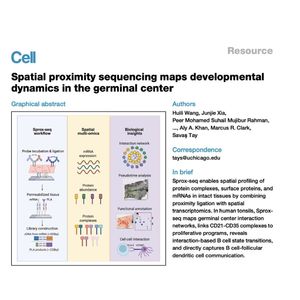
0The paper introduces Sprox-seq, a pioneering spatial multi-omic platform designed to simultaneously map mRNAs, protein abundance, and protein-protein interactions within intact tissue sections. By integrating proximity ligation assays with spatial transcriptomics, the technology allows researchers to visualize how molecular signaling and physical cell-cell contacts are organized geographically. When applied to human tonsil tissues, the method successfully identified distinct interaction networks in the germinal center, revealing that the light zone possesses higher complexity than the dark zone. Furthermore, the researchers utilized Sprox-seq to uncover B cell state transitions and functional trajectories that remain hidden when analyzing gene expression alone. The study specifically highlights the capture of VLA-4-VCAM1 interactions, directly linking physical communication between B cells and follicular dendritic cells to specific tissue regions. Ultimately, this resource provides a sophisticated framework for understanding how coordinated protein complexes drive biological functions across complex cellular landscapes.
References:
Wang H, Xia J, Rahman P M S M, et al. Spatial Proximity Sequencing Maps Developmental Dynamics in the Germinal Center[J]. bioRxiv, 2025: 2025.10. 27.684659.
