
**The thesis in one line:** The kill line looks like math, but it behaves like a verdict — read by a human with a calendar, a bonus, and a boss.
**How the line is drawn.** Inside a Chinese soft-launch review, four gates decide a game's fate. Retention first: a typical 2024 internal benchmark sheet suggested D1 under 40 percent or D7 under 15 triggered an automatic review meeting — rules of thumb, not laws. Then the money math: LTV over CAC, and a 2024 industry report suggested publishers wanted user acquisition paid back inside 60 to 90 days. Genre fit and ROI against the greenlight bet fill out the rest. The numbers are real signals; the reading of them is human.
**Conflict one — money or power?** Shawn insists the kill line isn't purely financial. He has personally killed profitable games: a quiet winner "restructured" because a senior VP needed heads to fill a failed bet. The math said keep it; the politics said kill it. Serevnt's counter: money sets the threshold, but politics decides whether it's enforced, ignored, or quietly moved.
**Conflict two — a system, not a person?** Serevnt pushes harder: "You call it politics. I call it a machine that trains developers to stop caring" — and asks who built it. Shawn answers he inherited it, not forged it, yet admits silence was a choice. The kill line doesn't just end projects; it ends trust.
**Conflict three — the unplanned coincidence.** Both hosts had separately met the same dead Western project. Shawn ran the publishing model and said "no." Serevnt read the dev post-mortem and said "maybe" — a better first ten minutes might have saved the D7 number. Same data, opposite verdicts. The gap between a publisher's line and a dev's read is exactly where salvageable games die.
**The public mirror.** Concord (Sony, launched August 2024, pulled within ~2 weeks; public reporting of losses in the hundreds of millions; studio folded) is the clean case — a Reddit developer called it "built by committee to chase a trend that had already moved on," and the core loop never landed. Helldivers 2 (launched February 2024; a March forced-account policy triggered review bombs) nearly died too, but Sony reversed course, listened, and moved the line — and lived.
**Key takeaways:**
1. Get the model in writing — ask for the actual retention and payback thresholds up front. A visible line is one you can design toward.
2. Design the first ten minutes like your life depends on it. Retention is won or lost in minute one.
3. Read the org chart, not just the contract. A scared VP is a different risk than a clean threshold.
4. Build a relationship with the human, not just the paper. The person who knows your name thinks twice before deleting it.
If you enjoy this AI edition, be sure to check out the original Chinese version, 游戏人有态度.
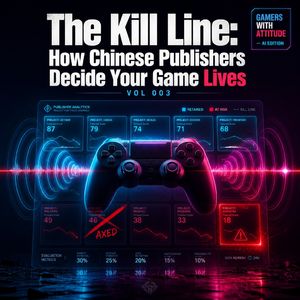
Vol 3. The Kill Line: China's Publishers and the Games They Kill
22分钟 · 0·
0· 0
0
00