
 5
5 0
0Title:
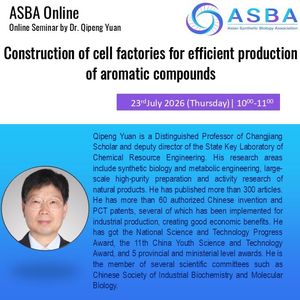
Construction of cell factories for efficient production of aromatic compounds
Astract:
The massive consumption of fossil resources and the rapid development of the chemical industry have greatly advanced human civilization; however, they have also led to challenges such as resource unsustainability and environmental pollution. Bio-manufacturing of aromatic chemicals offers a promising solution for achieving sustainable development, in which the construction of efficient artificial cell factories plays a central role and is expected to significantly promote the growth of the bioeconomy. This report outlines the current scientific and technological challenges in cell factory construction and discusses emerging technologies and strategies for developing efficient cell factories. Specifically, it highlights advances in exploring novel enzyme functions, discovering new biochemical reactions, designing and constructing non-natural metabolic pathways, creating metabolic driving forces, establishing stable self-regulating microbial co-culture systems, and dynamically regulating metabolic flux through quorum sensing. Using the biosynthesis of aromatic esters and the industrial production of arbutin as representative examples, this report provides insights into the green manufacturing of aromatic chemicals and demonstrates the vast potential of synthetic biology.
Personal Profile:
Qipeng Yuan is a Distinguished Professor of Changjiang Scholar and deputy director of the State Key Laboratory of Chemical Resource Engineering. His research areas include synthetic biology and metabolic engineering, large-scale high-purity preparation and activity research of natural products. He has published more than 300 articles. He has more than 60 authorized Chinese invention and PCT patents, several of which has been implemented for industrial production, creating good economic benefits. He has got the National Science and Technology Progress Award, the 11th China Youth Science and Technology Award, and 5 provincial and ministerial level awards. He is the member of several scientific committees such as Chinese Society of Industrial Biochemistry and Molecular Biology.
