

 0
0 0
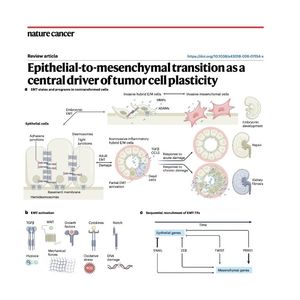
0This article explores epithelial-to-mesenchymal transition (EMT) as a fundamental mechanism of cellular plasticity that enables cancer cells to adapt, survive, and spread. Rather than a simple on-off switch, EMT is described as a multidimensional continuum of reversible states that facilitate metastasis, immune evasion, and drug resistance. The authors highlight how different EMT trajectories—ranging from embryonic-like invasive programs to adult-like inflammatory responses—create significant diversity within a single tumor. Beyond understanding disease progression, the text identifies vulnerabilities of mesenchymal cells, such as sensitivity to ferroptosis, which could be exploited for treatment. Ultimately, the review proposes innovative therapeutic strategies, including targeted protein degradation and logic-gated CAR T cells, to overcome the challenges posed by tumor adaptability.
References:
Jimenez-Castaño R, Nieto M A. Epithelial-to-mesenchymal transition as a central driver of tumor cell plasticity[J]. Nature Cancer, 2026: 1-16.
