

 4
4 0
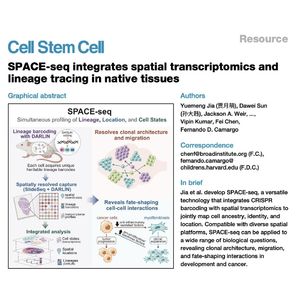
0Researchers have developed SPACE-seq, a versatile technology that integrates CRISPR-based barcoding with spatial transcriptomics to simultaneously map a cell’s ancestry, state, and location. By applying this method to liver cancer models, the authors discovered that clonally related tumor cells diversify into multiple distinct phenotypic states. The study also identifies a bidirectional crosstalk between tumor cells and the surrounding stroma, specifically showing how the protein SELENOP acts as a brake on fiber-producing cell expansion. Beyond cancer, SPACE-seq was used to reconstruct 3D lineage maps of the developing brain, revealing unique clonal patterns in the hippocampus. These findings demonstrate the platform's ability to uncover complex principles of tissue organization and cellular migration in both health and disease. This integration of lineage tracing with high-resolution spatial data provides a previously inaccessible view of how native tissues develop and transform.
References:
Jia Y, Sun D, Weir J A, et al. SPACE-seq integrates spatial transcriptomics and lineage tracing in native tissues[J]. Cell Stem Cell, 2026.
