

 0
0 0
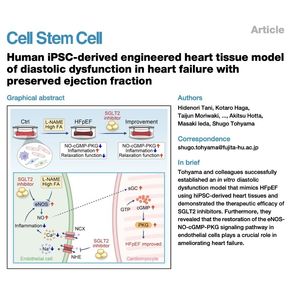
0Researchers have successfully developed a human engineered heart tissue model to study diastolic dysfunction in heart failure with preserved ejection fraction (HFpEF). By utilizing human induced pluripotent stem cells, the study effectively replicated key pathological traits, such as impaired relaxation and fibrosis, without the need for animal testing. The findings highlight that SGLT2 inhibitors provide significant therapeutic benefits by reducing inflammation and restoring critical cellular signaling pathways. This recovery is largely driven by the improvement of endothelial cell function and the stabilization of sodium and calcium levels. Ultimately, this sophisticated in vitro system offers a reproducible platform for discovering new treatments and understanding the complex mechanisms of human heart disease.
References:
Tani H, Haga K, Moriwaki T, et al. Human iPSC-derived engineered heart tissue model of diastolic dysfunction in heart failure with preserved ejection fraction[J]. Cell Stem Cell, 2026.
