

 0
0 0
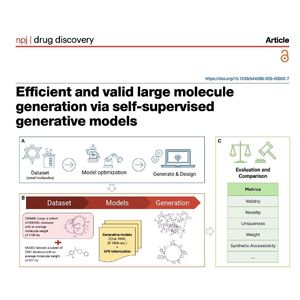
0This research explores the development of generative AI models specifically tailored for the design of large, complex molecules, which are often neglected in favor of small-molecule studies. The authors introduce a self-supervised learning framework and a novel tokenization method called Atom-Pair Encoding (APE) to overcome the computational inefficiencies and memory constraints of traditional graph-based models. By utilizing SELFIES and SMILES string representations, the study demonstrates that these enhancements significantly improve the validity, novelty, and scalability of generated structures. Results across diverse datasets show that the proposed methods effectively capture structural and chemical characteristics while enabling directional control over physical properties. Ultimately, this work provides a robust foundation for applying deep learning to advanced drug discovery and materials science.
References:
Kwak D, Chowdhury M R, Yoon B J, et al. Efficient and valid large molecule generation via self-supervised generative models[J]. npj Drug Discovery, 2026, 3(1): 20.
