

 1
1 0
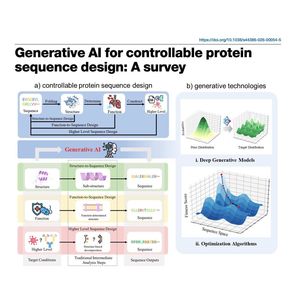
0This survey explores the revolutionary impact of generative AI on controllable protein sequence design, a field essential for advancing medicine and industrial chemistry. Traditional bioengineering methods are often limited by high costs and a narrow focus on known structures, whereas modern deep generative models allow researchers to explore vast, novel biochemical spaces with greater speed. The text categorizes design tasks into structure-to-sequence, function-to-sequence, and higher-level constraints, mapping these objectives to sophisticated frameworks like diffusion models and reinforcement learning. Beyond methodology, the source details essential databases for peptides and enzymes while providing a robust overview of in silico evaluation strategies used to verify structural stability and activity. Ultimately, the authors highlight a paradigm shift toward end-to-end design, identifying current data limitations and future opportunities for multimodal protein language models.
References:
Zhu Y, Kong Z, Wu J, et al. Generative ai for controllable protein sequence design: A survey[J]. npj Drug Discovery, 2026, 3(1): 19.
