

 1
1 0
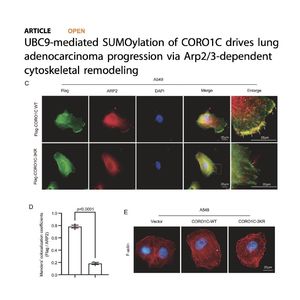
0This research article investigates the molecular mechanisms driving lung adenocarcinoma (LUAD) progression, focusing on the role of the enzyme UBC9. The study demonstrates that UBC9 is overexpressed in tumor tissues and correlates with a poor clinical prognosis for patients. Through detailed experiments, the authors identify Coronin-1C (CORO1C) as a key protein modified by UBC9 through a process called SUMOylation. This specific modification at three lysine residues enables CORO1C to interact more effectively with the Arp2/3 complex, which triggers the remodeling of the actin cytoskeleton. Such structural changes significantly boost the ability of cancer cells to proliferate, migrate, and metastasize throughout the body. Ultimately, the findings suggest that targeting this UBC9-CORO1C axis could serve as a promising new therapeutic strategy for treating advanced lung cancer.
References:
Zhang Z, Xiao B, Jiang Y, et al. UBC9-mediated SUMOylation of CORO1C drives lung adenocarcinoma progression via Arp2/3-dependent cytoskeletal remodeling[J]. Cell Death & Disease, 2026.
