

 0
0 0
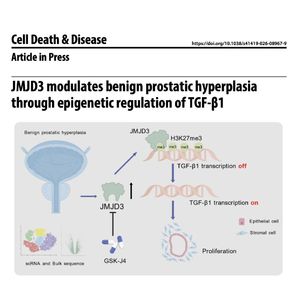
0This research study identifies the histone demethylase JMJD3 as a critical driver of benign prostatic hyperplasia (BPH), a common condition in aging men. By analyzing human samples and utilizing advanced sequencing methods, the authors found that JMJD3 expression is significantly elevated in BPH tissues and can be triggered by inflammatory stimuli like LPS. Mechanistically, the protein promotes disease progression by removing repressive epigenetic marks at the TGF-β1 promoter, which in turn activates signaling pathways that boost cell proliferation and cycle progression. Experimental results demonstrate that overexpressing this protein accelerates cell growth, whereas inhibiting it leads to cell death and arrested development. Crucially, the study shows that the small molecule inhibitor GSK-J4 effectively reduces prostate enlargement and inflammation in animal models. Ultimately, the findings suggest that targeting the JMJD3/TGF-β1 axis represents a promising new therapeutic strategy for managing BPH.
References:
Chen B, Li J, Huang Y, et al. JMJD3 modulates benign prostatic hyperplasia through epigenetic regulation of TGF-β1[J]. Cell Death & Disease, 2026.
