

 0
0 0
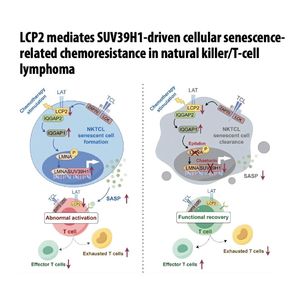
0This research investigates the role of lymphocyte cytosolic protein 2 (LCP2) in driving chemoresistance through cellular senescence in natural killer/T-cell lymphoma (NKTCL). The study demonstrates that repeated chemotherapy triggers therapy-induced senescence, which is marked by a significant reduction in LCP2 expression in both resistant cells and patient plasma. This deficiency activates the IQGAP2/LaminA/C/SUV39H1 signaling axis, promoting an immunosuppressive microenvironment that allows cancer cells to evade treatment. Experimental results show that low levels of LCP2 correlate with worse clinical outcomes and increased senescence-associated secretory phenotype (SASP) factors. Crucially, the authors found that combining senolytic agents like Epitalon and Chaetocin can clear these senescent cells and restore chemotherapeutic sensitivity. These findings establish LCP2 as a vital biomarker and offer a novel therapeutic strategy for treating relapsed or refractory NKTCL.
References:
Zhang Y, Qian S, Yang Q, et al. LCP2 mediates SUV39H1-driven cellular senescence-related chemoresistance in natural killer/T-cell lymphoma[J]. Cell Death & Disease, 2026.
