

 1
1 0
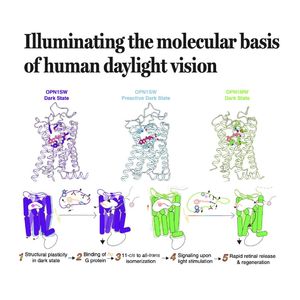
0This paper detail the structural mechanisms behind human daylight vision by examining two specific cone opsins, OPN1SW and OPN1MW. Using high-resolution cryo-electron microscopy, researchers identified how these proteins differ from rod cells to enable color perception and rapid signaling. The study reveals that OPN1MW utilizes a chloride ion to adjust its sensitivity to green light, while OPN1SW features a unique molecular architecture to detect blue light. These findings explain how the eye’s visual receptors manage fast retinal turnover and deactivation to process bright light effectively. By mapping these protein structures, the authors provide a molecular blueprint for the evolution of photopic vision and potential treatments for vision loss.
References:
Schmidt S L, Dostal J, Sen S, et al. Illuminating the molecular basis of human daylight vision[J]. Science, 2026, 392(6805): eadz3624.
