

 0
 0
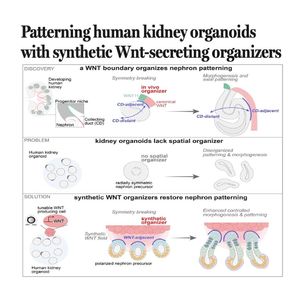
This research article describes the development of synthetic organizers to improve the structural organization of human kidney organoids. While natural human kidneys use WNT signaling boundaries near the collecting duct to guide nephron patterning, lab-grown organoids typically lack this spatial guidance, resulting in disorganized tissues. Scientists identified that a specific WNT11-WNT9B boundary establishes the necessary polarity for proper development in embryos. By engineering WNT-secreting cellular organizers and placing them next to organoids, the researchers successfully broke radial symmetry and restored axial polarity. These findings demonstrate that synthetic biology can reconstruct complex developmental geometries to guide the morphogenesis of engineered human tissues.
References:
Fausto C C, Glykofrydis F, Kumar N, et al. Patterning human kidney organoids with synthetic Wnt-secreting organizers[J]. Science, 2026, 393(6806): eadu9122.
