

 0
0 0
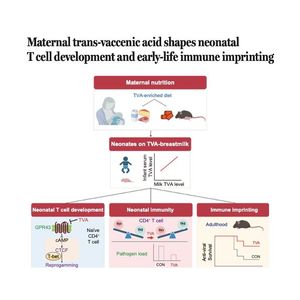
0Recent research demonstrates that maternal diet, specifically the intake of trans-vaccenic acid (TVA) found in dairy and beef, significantly influences the immune development of nursing offspring. By studying both mice and human clinical data, scientists found that TVA transfers through breast milk to expand and reprogram neonatal naïve CD4+ T cells. This molecular shift, which occurs via a specific GPR43-cAMP-PKA-CTCF pathway, transitions the infant's immune system from a Th2-biased state toward a Th1-skewed response. This reprogramming provides immediate benefits by reducing pathogen burden and increasing survival rates during early-life viral infections. Remarkably, this dietary exposure creates durable immune imprinting, ensuring enhanced antiviral immunity that persists well into adulthood. These findings suggest that a single dietary molecule can independently dictate long-term immune homeostasis, offering new strategies for optimizing infant nutrition.
References:
Fan H, Zheng Z, Oliphant K, et al. Maternal trans-vaccenic acid shapes neonatal T cell development and early-life immune imprinting[J]. Science, 2026, 392(6804): eaea4041.
