

 0
0 0
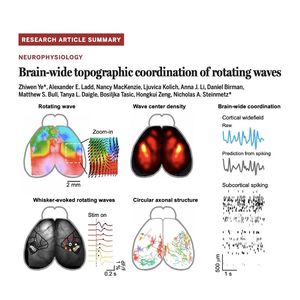
0The research article describes the discovery of rotating waves of neural activity that propagate across the mouse brain in circular patterns. Using wide-field calcium imaging and high-density electrode recordings, scientists identified that these electrical vortices are primarily centered in the somatosensory cortex and move sequentially across maps of the body surface. This activity is not random; it is dictated by a specific circular axonal architecture and is mirrored symmetrically between the brain's hemispheres and across sensory-motor boundaries. These waves are not limited to the surface but are coordinated with deeper subcortical structures, including the thalamus and striatum. Functionally, the study found that these rotating patterns are influenced by arousal levels and are actively recruited during the successful execution of visual-motor tasks. Ultimately, the research suggests that these waves serve as a fundamental organizational principle for coordinating information flow across diverse brain systems during perception and action.
References:
Ye Z, Ladd A E, MacKenzie N, et al. Brain-wide topographic coordination of rotating waves[J]. Science, 2026, 392(6804): eadx1369.
