

 3
3 0
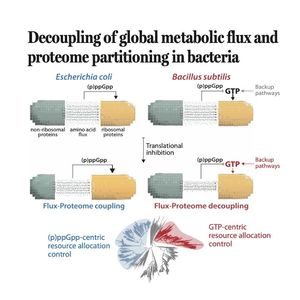
0This research article explores how different bacterial species manage their internal resources to balance growth and survival. While the well-studied Escherichia coli maintains a tight link between its metabolic production and protein composition through the alarmone (p)ppGpp, this study reveals that Bacillus subtilis utilizes a distinct strategy centered on GTP. In B. subtilis, translational stress causes a decoupling of metabolic flux from the proteome, allowing the bacteria to maintain stable ribosome levels while quickly dialing back amino acid production through feedback inhibition. This unique regulatory logic facilitates faster recovery from antibiotics and highlights a fundamental evolutionary trade-off between maximizing growth speed and ensuring stress tolerance. By comparing various lineages, the authors demonstrate that this GTP-based resource allocation is a widespread conservation strategy among Firmicutes, distinct from the Proteobacteria model. Ultimately, the findings prove that proteome composition alone cannot predict bacterial growth across all species, as metabolic and structural layers of the cell can be independently controlled.
References:
Thiermann R, Yang J, Zodage A, et al. Decoupling of global metabolic flux and proteome partitioning in bacteria[J]. Science, 2026, 392(6804): eaeb6410.
