

 3
3 0
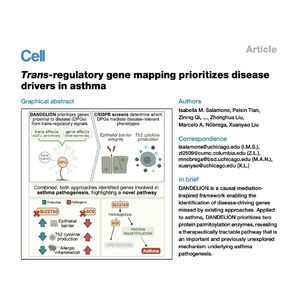
0Researchers have introduced DANDELION, a new computational framework designed to pinpoint disease-proximal genes (DPGs) that directly drive complex conditions like asthma. While traditional genetic studies often identify distal variants with indirect effects, this method integrates trans-regulatory signals and rare variant burden tests to reveal central biological drivers that other approaches miss. Applying this framework to asthma led to the discovery of a previously unknown role for protein palmitoylation in the disease's development. Experimental validation using CRISPR screens and mouse models confirmed that the enzymes SLC27A3 and SCD significantly influence lung inflammation and airway remodeling. Specifically, inhibiting SLC27A3 was found to be protective, improving epithelial barrier integrity and reducing harmful immune responses. These findings highlight DANDELION’s ability to uncover therapeutically actionable pathways by mapping the complex networks between genetic risk factors and core disease mechanisms.
References:
Salamone I M, Tian P, Qi Z, et al. Trans-regulatory gene mapping prioritizes disease drivers in asthma[J]. Cell, 2026.
