

 3
3 0
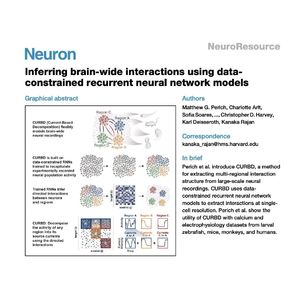
0The research introduces current-based decomposition (CURBD), a novel computational framework designed to map how different brain regions communicate. By using data-constrained recurrent neural networks (RNNs), the method reproduces observed neural activity to infer the direction and strength of hidden interactions between neurons. This approach allows researchers to decompose the activity of a target region into specific "source currents" arriving from other areas, revealing communication patterns that raw recordings cannot show. The authors demonstrate the system’s versatility by successfully applying it to diverse species, including zebrafish, mice, macaques, and humans. Ultimately, CURBD provides a scalable tool for untangling the complex, distributed neural dynamics that drive behavior across the whole brain.
References:
Perich M, Arlt C, Soares S. Inferring brain-wide interactions using data-constrained recurrent neural network models
Neuron, 2026; 0
