

 0
0 0
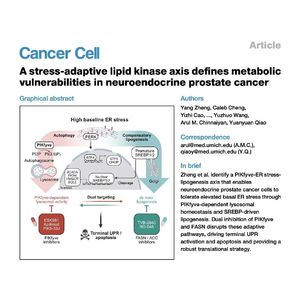
0This research article identifies PIKfyve as a highly expressed lipid kinase that serves as a critical survival factor for neuroendocrine prostate cancer (NEPC). The study reveals that NEPC cells utilize a PIKfyve-dependent pathway to manage high levels of endoplasmic reticulum (ER) stress and maintain metabolic stability. When PIKfyve is inhibited, the cancer cells launch a compensatory SREBP-driven lipogenesis program to survive the resulting cellular strain. By co-targeting PIKfyve and fatty acid synthase (FASN), researchers can disrupt this adaptive backup system and trigger widespread apoptosis. These findings highlight a new synthetic vulnerability that could be exploited to treat aggressive, therapy-resistant forms of prostate cancer. Preclinical models demonstrate that this dual-inhibition strategy effectively suppresses tumor growth and improves survival outcomes.
References:
Zheng Y, Cheng C, Cao Y, et al. A stress-adaptive lipid kinase axis defines metabolic vulnerabilities in neuroendocrine prostate cancer[J]. Cancer Cell, 2026.
