

 2
2 0
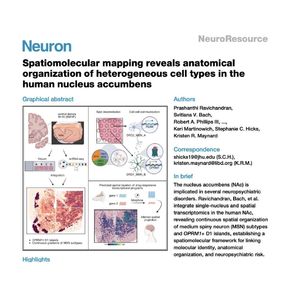
0The research presents a high-resolution spatiomolecular atlas of the human nucleus accumbens, a critical brain region involved in motivation, addiction, and psychiatric health. By integrating single-nucleus RNA sequencing with spatial transcriptomics, the authors identified twenty distinct cell types and mapped their precise anatomical distribution. A major discovery includes the characterization of D1 islands, unique cellular clusters enriched for the mu-opioid receptor (OPRM1) that serve as evolutionary conserved hubs for reward processing. The study demonstrates that neuronal diversity is organized along continuous transcriptional gradients rather than rigid boundaries, linking these molecular patterns to genetic risks for depression and schizophrenia. Furthermore, the researchers utilized machine learning to project rodent drug-response data onto the human brain, predicting how specific spatial domains react to morphine and cocaine. Ultimately, this work provides a foundational framework for understanding how the physical and chemical architecture of the brain influences neuropsychiatric disorders.
References:
Ravichandran P, Bach S V, Phillips R A, et al. Spatiomolecular mapping reveals anatomical organization of heterogeneous cell types in the human nucleus accumbens[J]. Neuron, 2026.
