

 2
2 0
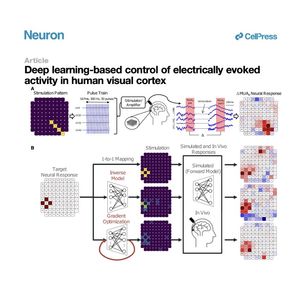
0This research introduces a deep learning framework designed to improve the performance of visual cortical prostheses by modeling and controlling neural activity in the human brain. Using data from a blind participant with a bidirectional brain implant, the authors developed a forward neural network to predict how electrical stimulation drives population responses while accounting for daily fluctuations in brain states. They implemented gradient-based optimization and inverse neural networks to synthesize stimulation patterns that precisely shape neural activity, outperforming traditional linear mapping methods. The study reveals that achievable brain responses are constrained by a low-dimensional neural manifold, meaning stimulation effectiveness depends on the brain's natural activity patterns. Furthermore, the researchers found that recorded neural activity is a much more accurate predictor of a patient’s actual perception than the stimulation settings alone. These findings establish a closed-loop foundation for restoring sight by treating neural population responses as the essential link between electrical input and human perception.
References:
Moure P, Granley J, Grani F, et al. Deep Learning–Based Control of Electrically Evoked Activity in Human Visual Cortex[J]. bioRxiv, 2025.
