

 4
4 0
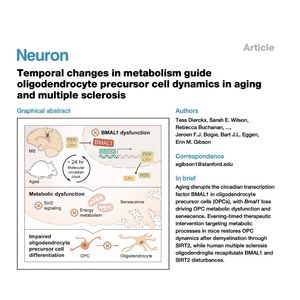
0The research identifies the circadian transcription factor BMAL1 as a vital regulator of metabolic health and cellular aging within oligodendrocyte precursor cells (OPCs). Aging and multiple sclerosis (MS) cause BMAL1 dysfunction, which triggers a cascade of mitochondrial defects, metabolic imbalances, and cellular senescence that ultimately impairs myelin repair. By utilizing evening-timed chronotherapy with sirtuin-activating drugs like metformin, the researchers successfully rejuvenated dysfunctional OPCs and improved remyelination in mouse models. Similar disruptions in circadian rhythmicity and SIRT2 expression were confirmed in human MS patients and stem-cell-derived models. These findings establish a direct link between the biological clock and energy homeostasis, suggesting that precisely timed medical interventions could offer a novel strategy for treating neurodegenerative decline. This work highlights how the temporal gating of cellular processes is essential for maintaining the brain’s regenerative capacity across the lifespan.\
References:
Dierckx T, Wilson S E, Buchanan R, et al. Temporal changes in metabolism guide oligodendrocyte precursor cell dynamics in aging and multiple sclerosis[J]. Neuron, 2026.
