

 0
0 0
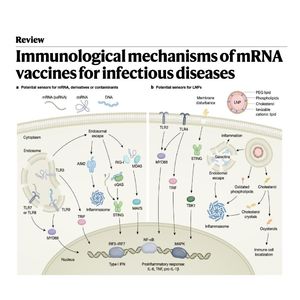
0This review explores the immunological mechanisms underlying the success of mRNA-lipid nanoparticle (mRNA-LNP) vaccines, which gained global prominence during the COVID-19 pandemic. The authors describe how nucleoside modifications and LNP delivery systems work together to trigger a coordinated response from both the innate and adaptive immune systems. While these vaccines are highly effective at inducing neutralizing antibodies and robust germinal center responses, the text identifies ongoing challenges such as waning immunity and vaccine reactogenicity. Current research aims to better understand how the body's pattern-recognition receptors sense these components to allow for the rational design of next-generation formulas. By fine-tuning LNP chemistry and mRNA stability, scientists hope to enhance the durability and safety of future vaccines against diverse infectious diseases. The sources emphasize that moving from emergency use to long-term application requires resolving the mechanistic gaps in how these platforms communicate with human immune cells.
References:
Locci M, Pardi N. Immunological mechanisms of mRNA vaccines for infectious diseases[J]. Nature, 2026, 654(8120): 892-901.
