

 0
0 0
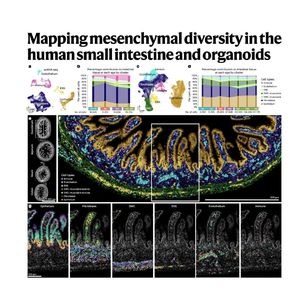
0The research establishes a spatially resolved atlas of the developing human small intestine by integrating single-cell RNA-sequencing with spatial transcriptomics. The study identifies five distinct fibroblast subpopulations—including subepithelial, lamina propria, and submucosal cells—and maps their precise anatomical locations during development. By defining molecular markers for these diverse mesenchymal groups, the authors provide a framework for distinguishing cell types in both imaging and sequencing data. This high-resolution map further serves as a benchmark to evaluate the structural fidelity of human intestinal organoids derived from pluripotent stem cells. Ultimately, this work offers a blueprint for understanding how tissue architecture influences cellular signaling and function in health and disease.
References:
Johnson K F, Dong X, Tsai Y H, et al. Mapping mesenchymal diversity in the human small intestine and organoids[J]. Nature Cell Biology, 2026: 1-13.
