

 1
1 0
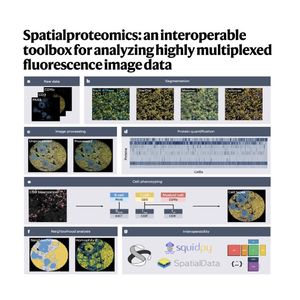
0The paper introduces spatialproteomics, a versatile Python package designed for the comprehensive analysis of highly multiplexed fluorescence imaging data. This toolbox addresses a critical need for an end-to-end workflow, streamlining complex tasks such as cell segmentation, protein quantification, and cell phenotyping. By utilizing an interoperable framework, the software ensures that various data types, from raw images to expression matrices, remain synchronized across shared spatial dimensions. Researchers demonstrated the utility of this tool by analyzing over 3.5 million cells from patients with B cell lymphomas, revealing how tissue architecture and cell-to-cell interactions change between healthy and diseased states. Furthermore, the package is built for scalability, capable of processing massive gigapixel images while maintaining compatibility with the broader scverse ecosystem. Ultimately, spatialproteomics provides a robust, modular environment for biologists to extract meaningful statistical insights from high-dimensional tissue samples.
References:
Meyer-Bender M, Voehringer H, Schniederjohann C, et al. Spatialproteomics: an interoperable toolbox for analyzing highly multiplexed fluorescence image data[J]. Nature Methods, 2026: 1-10.
