

 0
0 0
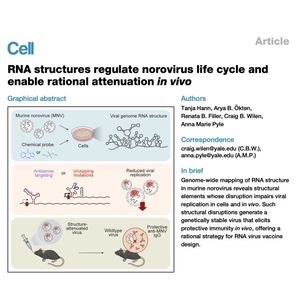
0This research characterizes the complete RNA secondary structure of the murine norovirus genome within infected cells, identifying a complex network of regulatory motifs located primarily in protein-coding regions. By using high-throughput chemical probing and evolutionary analysis, the authors discovered that these structured RNA elements are highly conserved and essential for the viral life cycle. Specifically, two structures, lowSS1 and lowSS10, were found to act as translational regulators that fine-tune the production of viral proteins. Disruption of these motifs through synonymous mutations significantly weakens viral replication and reduces disease severity in animal models. These findings enabled the development of a rationally attenuated virus that remains genetically stable and provides protective immunity against subsequent infections. Ultimately, the study establishes a new framework for vaccine design by targeting the functional architecture of viral RNA.
References:
Hann T, Ökten A B, Filler R B, et al. RNA structures regulate norovirus life cycle and enable rational attenuation in vivo[J]. Cell, 2026.
