

 0
0 0
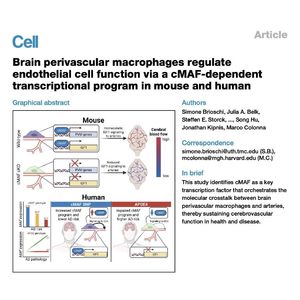
0This scientific research identifies the transcription factor cMAF as the essential regulator of brain perivascular macrophages in both mice and humans. These specific immune cells are located along cerebral arteries, where they utilize a cMAF-dependent program to produce IGF1, a signaling molecule that sustains healthy blood flow and cerebrospinal fluid circulation. When cMAF is deleted, these macrophages lose their specialized identity, leading to vascular dysfunction and impaired physiological responses. The study further reveals that this molecular crosstalk is disrupted in Alzheimer’s disease patients carrying the APOE4 risk allele. Conversely, genetic variants that increase cMAF expression appear to offer neuroprotective benefits against dementia. These findings suggest that therapeutic strategies targeting the cMAF-IGF1 pathway could help treat neurodegenerative and cerebrovascular diseases.
References:
Brioschi S, Belk J A, Storck S E, et al. Brain perivascular macrophages regulate endothelial cell function via a cMAF-dependent transcriptional program in mouse and human[J]. Cell, 2026.
