

 2
2 0
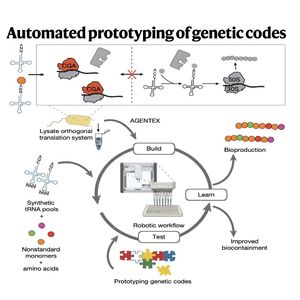
0Researchers have developed AGENTEX, an automated robotic platform designed to prototype and test synthetic genetic codes within cell-free translation systems. This innovation relies on the discovery that natural aminoacyl tRNA synthetases possess significant flexibility, allowing them to charge engineered tRNAs even when their universal 3′ CCA terminal sequence is mutated. By pairing these non-standard tRNAs with mutant ribosomes that specifically recognize altered 3′ ends, the system creates a parallel translation channel that avoids crosstalk with the host's native machinery. To support this workflow, the team created tSCAN, a high-throughput sequencing method that quantifies how effectively different tRNA designs are aminoacylated in complex mixtures. These tools enable the rapid construction of compressed genetic codes, facilitating the precise incorporation of non-standard amino acids for new therapeutics and materials. Ultimately, this work offers a modular strategy to redesign the fundamental process of translation and explore alternative evolutionary paths for genetic encoding.
References:
Radford F, Sapers N, Burgess H M, et al. Automated prototyping of genetic codes[J]. Nature, 2026: 1-11.
