

 0
0 0
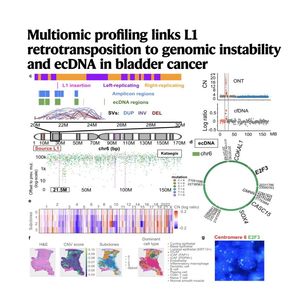
0This research utilizes an integrated multi-omic approach to examine the molecular drivers of bladder cancer progression across a cohort of 48 patients. By combining long-read DNA sequencing, spatial transcriptomics, and cell-free DNA analysis, the authors identify a critical link between somatic LINE-1 (L1) retrotransposition and increased genomic instability. The study demonstrates that early L1 insertions trigger downstream chromosomal rearrangements, including the formation of extrachromosomal DNA (ecDNA) and complex structural variants. Furthermore, the data suggest that these genetic alterations elicit a viral mimicry response and activate APOBEC3B-mediated mutagenesis, contributing to tumor aggressiveness. These findings position L1 elements as potential biomarkers for risk stratification and highlight novel therapeutic targets for managing recurrent disease. Combined with epigenetic profiling, this holistic view reveals how chromatin relaxation and promoter hypomethylation facilitate the genomic stress driving bladder malignancy.
References:
Pribus S J, Osredek I, Otoničar J, et al. Multiomic profiling links L1 retrotransposition to genomic instability and ecDNA in bladder cancer[J]. Nature Communications, 2026, 17(1): 6384.
